 Spann Fitness
Home Gym · Equipment · Landmine Training · 6 min read · Updated November 2026
Barbell vs Dumbbells: Which Should a Home Gym Buy First?
Barbell vs dumbbells is the first real fork in a home gym, and our answer is: buy the barbell first if you want to load big lifts heavy for years, buy a few dumbbells first if the room is tight and most of your work is one arm or one leg at a time. A barbell gets you heavy two-handed pulling, squatting and pressing from one tool and a stack of plates. Dumbbells get you independent sides and freedom of path, but every heavier pair is another purchase. A landmine sleeve sits between the two, and that's the part most buying guides skip.
What a barbell does that dumbbells can't
Load. We'd put it this way to anyone setting up a garage: one bar and a set of plates covers a deadlift, a squat, a press and a row, and adding weight costs you another plate, not another implement. If the plan is to keep getting stronger on the big lifts, nothing at home scales the way a bar does.
The catch is the footprint around it. A standard Olympic bar, going by the IWF men's competition specification, is 86.6 inches long and 44 pounds empty. Squatting or pressing it heavy at home realistically means a rack with safeties, which is the single biggest item most garages ever hold. Deadlifts and rows can come off the floor without one. Squats and overhead work, done heavy, shouldn't.
What dumbbells do that a barbell can't
Each hand works on its own. You can press one arm at a time, row one side while the other braces on a bench, carry a weight in one hand and walk. Your wrists and shoulders choose their own path instead of following a straight bar, and a lot of lifters find that friendlier on a cranky joint.
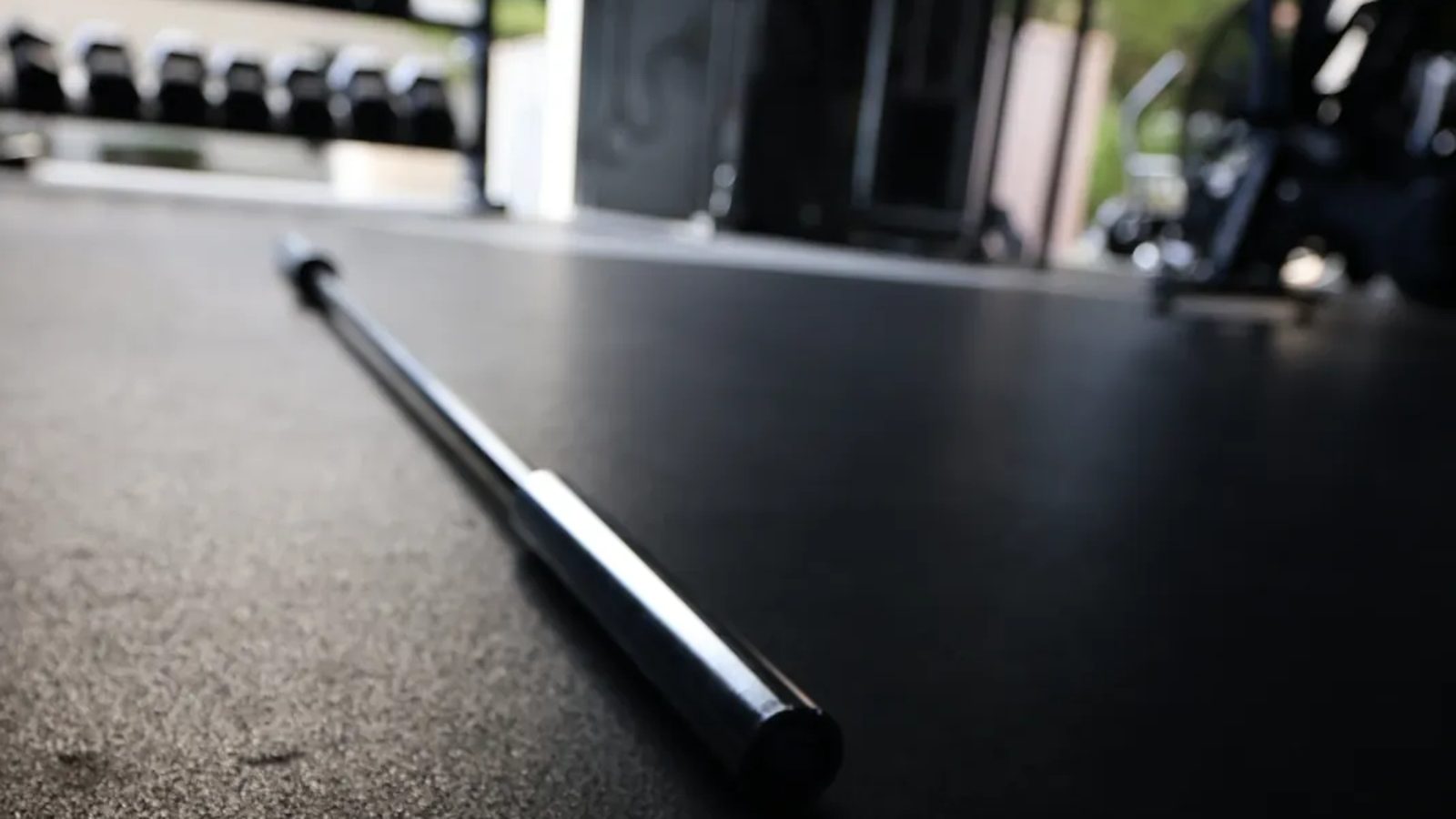
The downside is the rack behind them. A useful range of dumbbells is a lot of pairs, and every jump in weight is a separate pair you have to buy and store. Adjustable dumbbells fix the storage and add their own trade: a ceiling on how heavy they go, and a handle you change between sets. For a lighter, varied program that's fine. We'd never tell anyone to throw theirs out; there's a full rack of them behind the bar in the photo at the top of this page. For heavy lower-body work you'll run out of dumbbell long before you run out of leg.
Where the landmine changes the answer
Our whole business sits here, so take this part with that in mind. A landmine puts one end of a bar in a pivot on the floor and the other end in your hands. That gives you the barbell's loading, with plates sliding onto a single sleeve, and a lot of the dumbbell's one-sided work: single-arm presses, single-arm rows, rotations, split-stance lifts. The bar runs on an arc, so it guides the path without locking you into a straight line.
It also skips the rack for a whole family of lifts. A single-arm landmine press or a landmine squat starts from the floor or from a bar resting at hip height. There's nothing to unrack and nothing to bail out of overhead.
That's the job we built the Spann Bar for. Every size loads on one 7.5 inch sleeve, fits a standard 2-inch landmine sleeve and is rated to 550 lb. For home gyms the store's own sizing points most people at the Velencia, 34 lb and 87 inches long. If your floor is shorter than that, the 77 inch Fresh Bar or the 78.4 inch Melo Bar pull everything closer to the pivot.
What we'd buy first, by situation
If you've got a full bay of a garage and you want to deadlift and squat heavy for a long time: a standard barbell, plates and a rack. Add a landmine attachment to the rack later for the single-arm work.
If you've got half a garage, a low ceiling, or you train around a car: a landmine attachment, a landmine bar and plates. You give up the heavy back squat and the barbell bench, and you keep heavy single-arm pressing and rowing, squats, deadlift patterns and rotation in one strip of floor. The footprint check is in how much space a landmine setup needs.
If you've got a corner and a closet: a short run of dumbbells you'll actually use, light to moderate. Buy the middle of your range first. The very light and very heavy pairs are the ones that gather dust.
Here's the one we'd argue for. Whichever you start with, the plates are the real investment. Olympic plates load a standard bar and a landmine bar alike, so a plate bought on day one still earns its floor space five years later. Dumbbells don't share anything with the rest of the room.
Do you need both eventually?
Most home gyms end up with some of each. A pair or two of dumbbells for carries and accessory work sits fine next to a bar. What we'd avoid is buying a full dumbbell rack before you know what you train most, because it's the most floor and the most money for the least flexibility.
If the landmine route is the one that fits your room, pick a length from the Spann Bar sizes on the store against your tape measure, not against the bar that looks heaviest.
Your bar.
Five sizes from 15.5 lb. Fits a standard 2-inch landmine sleeve. 550 lb capacity. 1-year limited warranty, 30-day returns.
Order your barThe first and only patent-approved barbell designed for landmine sleeve attachment.