 Spann Fitness
Landmine training · Pressing · Programming · 6 min read · Updated November 2026
Can the Landmine Press Replace the Bench Press?
No, and the reason is the pivot. A bench press moves the weight away from your chest on a path your arms choose, with your back on a bench. A landmine press moves the free end of the bar on a path the sleeve already chose, with you standing up, and that path climbs. You can make it climb less steeply by standing further back. That is the one dial you have, and it is not enough to flatten the movement into a bench press. Run the landmine press as its own press at its own angle, and keep the bench if your program needs a bench.
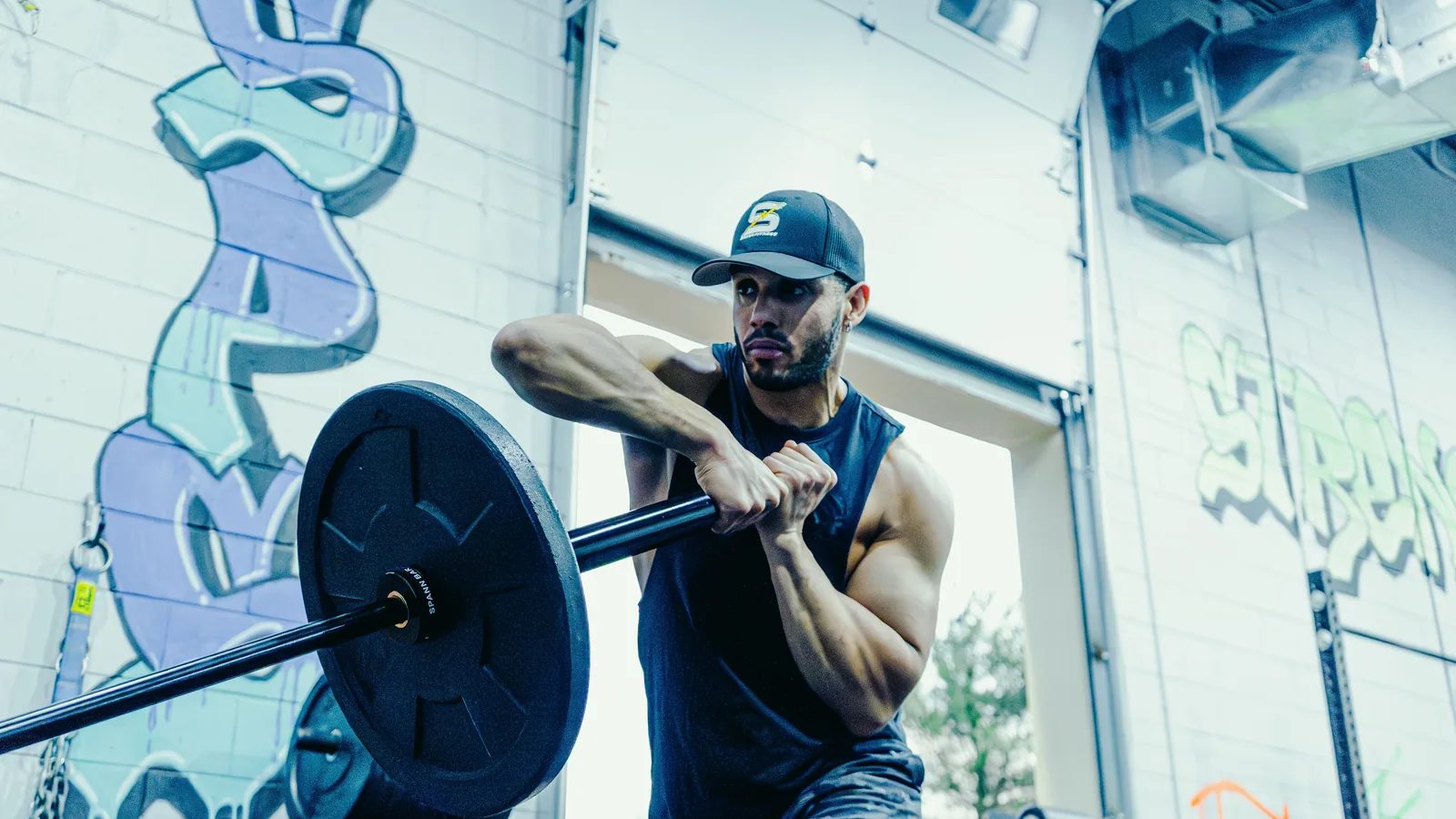
What the pivot does to the path
Both ends of a barbell on a bench are free. The bar goes where your arms send it, which is usually a shallow curve from the chest back over the shoulders, and the only thing deciding that curve is you.
Drop one end into a sleeve and that changes. The pinned end is now the centre of a circle and the free end is stuck on the edge of it, at a radius equal to the length of the bar. No amount of coaching gets the free end off that circle. It is geometry, and it is the whole reason this question keeps coming up.
What falls out of the geometry is that the loaded end cannot travel flat at chest height for any distance. From a start at your chest it goes up, and it goes out. The card for this movement in our exercise library calls it pressing up and away along the line the bar wants to travel, and the away is carrying as much weight there as the up.
Where you stand sets the angle
This is the part people miss, and it is the only real adjustment on the movement. How steep the press feels is set by how far you stand from the sleeve, because your distance and the bar's length together decide what angle the bar sits at when it reaches your shoulder.
Stand in close and the bar is steep at your hands. The press runs almost vertical and starts to feel like an overhead press on rails. Walk back toward the free end and the bar lies flatter, the start drops lower on your chest, and the press takes on more forward and less up. Same movement, same sleeve, different angle.
So the length of your bar is the range of angles you get. Our shortest, the Fresh Bar, measures 77 inches and weighs 15.5 lb. Step up to the Velencia and you get 87 inches at 34 lb, while the flagship Spann Bar runs 94.1 inches at 43 lb. Shortest to longest, that is roughly 17 inches of extra floor to put your feet on, which is worth knowing before you pick a size. We took the sizes one at a time in what size landmine bar you need.
Two hands or one
The closest thing to a chest press you will get here is the two-handed version. Both hands wrapped on the loaded end, held in at the sternum, pressed out and up together. The store's own movement list names single and double-arm presses, and this is the double.
One hand is a different question. With a single hand on the grip the bar pulls you toward your working side through the whole rep, and the job for everything below your shoulders is to refuse that. Hips square to the sleeve, ribs down, and you will know immediately if they are not. That makes it a press with a holding-still problem attached, which is not what most people mean when they say chest day.
What it cannot do
Be straight with yourself about the gap. On a flat bench your back is supported, your feet are planted, and the load runs horizontally away from your chest. Nothing else has to hold you up, which is why it loads heavy and goes up in small steps.
Standing at a landmine, you hold your own trunk for every rep, on a path that rises. If your program has a horizontal push in it for an actual reason, the landmine press is not that lift, and swapping it in quietly rewrites the program. If the horizontal push was only ever there because the bench was the press you knew, that is a different conversation and worth having.
Do not try to match loads across the two either. Where the weight sits in your hand keeps changing as a landmine rep travels, so a bench number and a landmine number are not the same currency. Chase the bench number on a landmine and the press turns into a lean-back shove.
How we would run it
If you want the flattest press a landmine gives you, stand back far enough that the loaded end starts at the bottom of your sternum with your elbows down and your feet still under you. Take it in both hands and work in the 8 to 12 range. Push the plates out away from your chest and let the bar finish long and high in front of you.
If you already bench, this is extra pressing at an angle you otherwise never train, and it sits well on a second upper day after the main lift.
The vertical version of this same argument, the landmine press measured against the overhead press, is a separate post: landmine press vs overhead press.
Common questions
- Is the landmine press a chest exercise?
- It is a press that travels on a rising arc. How much of it reads as a chest press depends on how far back you stand and whether you use one hand or two. We will not tell you which muscles do what, because that needs a study rather than a blog post. What we can tell you is the path, and the path climbs.
- How far from the sleeve should I stand?
- Far enough back that the loaded end starts at the bottom of your sternum with your elbows down, and close enough that your feet are still under your hips rather than reaching. The length of the bar caps how far back you can get.
Your bar.
Five sizes from 15.5 lb. Fits a standard 2-inch landmine sleeve. 550 lb capacity. 1-year limited warranty, 30-day returns.
Order your barThe first and only patent-approved barbell designed for landmine sleeve attachment.