 Spann Fitness
Landmine training · Squatting · Technique · 6 min read · Updated October 2026
How To Squat With a Landmine
Face the sleeve, take the loaded end of the bar in both hands at your chest, and squat down along the arc the bar travels on. Feet about shoulder width, elbows tucked, knees tracking over your toes, then stand back up. That is a landmine squat. The part that takes a few sessions is how far you stand from the sleeve, because that is what decides how much the bar leans you forward at the bottom. Our landmine squat card has the bare mechanics. This is the rest of it.
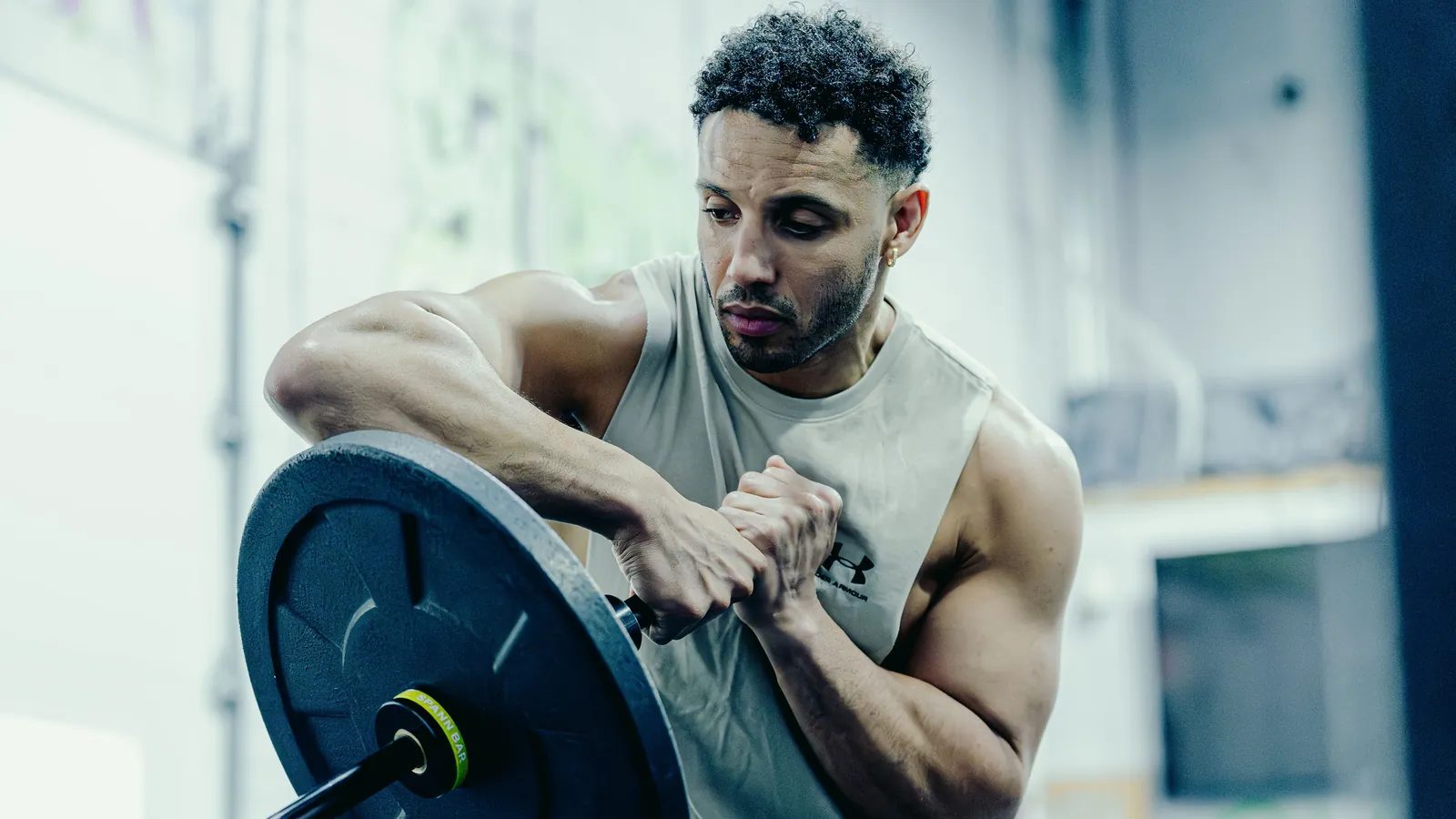
Most people asking have one of two reasons. Either there is no squat rack in the room, or there is one and they want a squat that loads the front of the body instead of sitting across the back. Both end up at the same movement, and it behaves differently from either a back squat or a dumbbell held at the chest, because one end of the bar is pinned in the sleeve and cannot go anywhere you do not take it.
How far you stand from the sleeve sets everything
Put the bar in the attachment, load the free end, then face it. Your distance from the pivot sets the angle of the bar, and the angle of the bar sets how far your chest travels forward as you go down. Nobody tells you this part and it is the whole setup.
Stand too far out and the bar lies almost flat, so it pulls your chest toward the floor on the descent and you finish the rep somewhere closer to a good morning. Stand too close and the end stands up steep, the plates crowd your chin, and there is nowhere for the bar to go at the bottom.
Walk in or out a few inches at a time until you can hold the end against your chest with the elbows pointing down and your torso only tipped slightly forward at the bottom. That slight forward lean is not a fault to correct. It is the reason to squat here rather than under a bar.
The hold is where reps go wrong
Both hands on the end of the bar, held in to the chest, elbows tucked rather than flared out wide. The grip sits right behind the plates on our bars, so there is a natural place for the hands that keeps the load close to the body.
The fault we see most on the floor is the end of the bar drifting away from the chest on the way down. Once it travels out in front of you, your arms are holding the weight out at arm's length and the squat turns into a reach, which is why the last two reps of a set tend to look nothing like the first two.
Keep the end touching or nearly touching the chest the whole way down and the whole way up. If it cannot stay there, that is the set telling you the load is too heavy, not a cue problem.
The setup, step by step
Eight to fifteen reps is where we keep most people on this one. It is a front-loaded squat, so the hold usually gives out before the legs do, and a set that ends with the bar sliding down the chest ended a rep or two earlier.
- Load the free end
Bar in the landmine attachment, standard Olympic plates on the loadable end. Start lighter than you would for a back squat: the arc changes how the weight feels against your chest and the numbers do not carry across.
- Find your distance
Face the sleeve and walk in or out until the bar sits at an angle that lets you hold the end at your chest with your torso close to upright.
- Take the hold
Both hands on the end, elbows down and tucked in, the end of the bar against your chest. Feet about shoulder width, toes where you normally squat.
- Brace, then descend
Breathe in, brace, and squat down along the arc rather than straight down. Knees track over the toes. Let the bar carry your torso into its slight forward lean instead of fighting it.
- Stand up
Drive the floor away and stand, keeping the end of the bar in the same place against your chest the whole way.
- Reset between reps
Stand tall, re-brace, then go again. Depth is whatever you can control on the way back up, and that number drops as the set goes on.
The bar you own shows up on the first rep
This is the movement where size stops being an abstract question, for two reasons.
The first is that there is no lighter option than the bar on its own. Nothing smaller exists to start with, and across our lineup the starting point is 15.5 lb, 25 lb, 34 lb, 37 lb or 43 lb before a plate goes near it.
The second is the one that catches people out. One end of the bar is sitting in the sleeve, and the sleeve is carrying part of the bar's weight, not your hands. So what you are actually holding at your chest is less than the figure printed on the bar's spec. We do not publish a number for it, because it shifts with the length of the bar and with how far from the pivot you are standing, and a number we cannot stand behind is worse than no number.
If squats are a big part of why you are buying, the lighter end of the range is where our FAQ points. It lists the Fresh Bar at 15.5 lb for "Youth athletes, rehab, beginners, high-rep work." and the Melo at 25 lb, the bar in the photo at the top of this page, for "Speed work, agility, youth athletes, light conditioning." Those are the FAQ's words, not a recommendation we are adding on top. What size landmine bar you need works through the whole lineup.
What the setup actually needs
A landmine attachment, sleeve-mounted, rack-mounted or a corner, plus standard Olympic plates. That is the list. No rack, no spotter arms, no adapters.
Every size we make fits standard 2-inch landmine sleeves and takes 550 lb, and each one has the same 7.5 inch loadable end, so the hardware side of a squat is the same whichever bar is in the room. If the attachment side is new to you, what a landmine barbell is covers it from the start.
Common questions
- Is a landmine squat the same as a goblet squat?
- They are both front-loaded, so they feel related. The difference is the fixed end. A goblet squat holds a free weight that travels straight up and down, while a landmine squat follows the arc of a bar pinned in the sleeve, which tips your torso slightly forward at the bottom and takes some of the weight into the attachment rather than your hands.
- How deep should I go on a landmine squat?
- As deep as you can control on the way back up. The usual limit is the hold rather than the legs: when the end of the bar starts sliding down off the chest at the bottom, that is the depth to work at for now.
- Can you do a landmine squat without a squat rack?
- Yes. The weight is held at your chest and one end of the bar is fixed in the attachment, so a rack is not part of the setup. You need a landmine attachment, sleeve-mounted, rack-mounted or a corner, and standard Olympic plates.
- Which size bar suits landmine squats?
- Start from the fact that the bar alone is your opening load, so the lighter sizes give you more room to work in. Our FAQ lists the Fresh Bar at 15.5 lb for "Youth athletes, rehab, beginners, high-rep work." and the Melo at 25 lb for "Speed work, agility, youth athletes, light conditioning." Every size takes the same 550 lb, so a lighter bar is not a weaker one.
Your bar.
Five sizes from 15.5 lb. Fits a standard 2-inch landmine sleeve. 550 lb capacity. 1-year limited warranty, 30-day returns.
Order your barThe first and only patent-approved barbell designed for landmine sleeve attachment.